Skip to content
Let me tell you about a conversation I had last year with a sawmill owner in Vietnam. He was sitting on 20 tons of sawdust and wood offcuts every month — paying people to haul it away. He knew there was money in those piles, but his little briquette press could only chew through 200 kg per day. He was stuck.
Fast forward 12 months. He installed a wood charcoal briquette press for large scale — a proper industrial line that runs 24/7. Today, he’s exporting charcoal briquettes to South Korea and making more profit from his waste than from his lumber. His story isn’t unusual. I’ve seen the same transformation happen again and again.
If you’re sitting on a mountain of wood waste — sawdust, coconut shells, palm kernel shells, or agricultural residues — and you’re ready to turn it into a serious business, this guide is for you. I’ll walk you through what large‑scale briquette production looks like, what equipment you need, how much it costs, and how to choose the right system for your operation.
What Does “Large Scale” Actually Mean?
Before we dive in, let’s get clear on what we’re talking about. A wood charcoal briquette press for large scale isn’t just a bigger version of a small workshop machine. It’s a completely different animal.
Small‑scale briquette presses produce 50–200 kg per hour. They’re fine for testing the market or serving a handful of local customers. Large‑scale industrial lines, by contrast, start at 500 kg per hour and go up to 3 tons per hour or more. They run continuously, often 24 hours a day, with automated feeding, mixing, extrusion, cutting, and drying.
A complete industrial charcoal briquette production line typically includes:
-
Crusher or hammer mill – Reduces raw biomass to uniform particles (under 10 mm).
-
Rotary dryer – Lowers moisture content to below 15% for optimal briquetting.
-
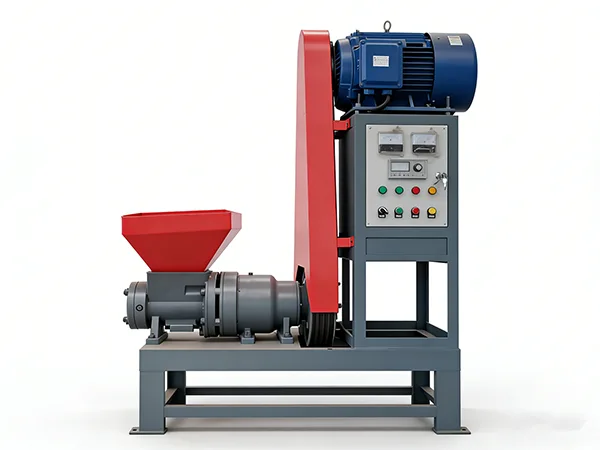
Briquette press – The heart of the line. Compresses material into dense briquettes using either a screw extruder or a ring‑die roller system.
-
Carbonization furnace – Optional but highly recommended if you’re making charcoal briquettes rather than raw biomass fuel.
-
Cooling and packaging system – Cools and bags the finished product.
The difference between small and large scale isn’t just about output — it’s about consistency, quality, and profitability per ton. A commercial charcoal briquette equipment line produces uniform briquettes that command premium prices in export markets.
Why Go Large Scale? The Economics of Scale
Here’s what I’ve learned from watching dozens of producers make the leap: the numbers get dramatically better when you scale up.
Lower Cost Per Ton
A small press might cost you $50 per ton in labor and energy. A large‑scale **high capacity charcoal briquette press** can bring that down to $15–$20 per ton. Why? Because the machine runs continuously with minimal supervision, and the fixed costs are spread across much higher volume.
Access to Premium Markets
Small producers are limited to local barbecue shops and street vendors. They might get $200–$300 per ton. A large‑scale operation can supply export markets, where premium charcoal briquette for hookah or activated carbon can fetch $500–$1,000 per ton or more. But export buyers demand consistency — uniform size, density, and burn time. Only an automated industrial line can deliver that.
24/7 Operation
People get tired. Machines don’t. A continuous briquette extruder runs day and night, only stopping for scheduled maintenance. That means more output from the same capital investment.
Carbonization Adds Value
If you’re selling raw biomass briquettes, you’re competing with every other fuel supplier. But if you add a carbonization furnace after the briquette press, you’re producing high‑fixed‑carbon charcoal briquettes that burn without smoke. That’s a completely different product — one that commands much higher prices.
Many large‑scale producers use a two‑step process: first make briquettes, then carbonize them in a continuous horizontal furnace. The syngas released during carbonization is captured and recycled to fuel the furnace, cutting external energy costs by 30–50%.
Types of Large Scale Briquette Presses
There are two main technologies for large‑scale briquette production. Each has its strengths.
Screw‑Type Extruders
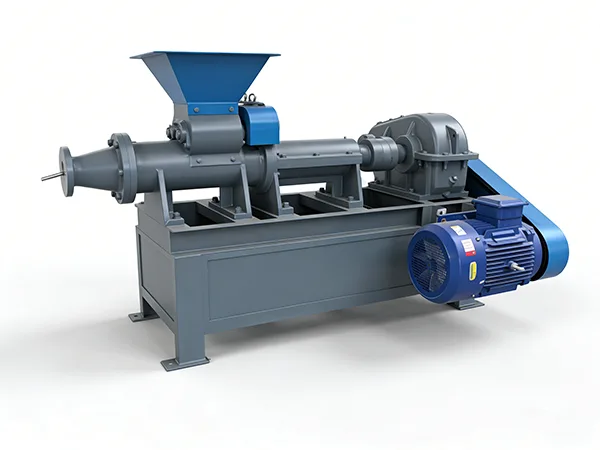
A screw‑type briquette press uses a heated screw to force material through a tapered die. It produces solid logs with a hole in the center — the classic shape for BBQ briquettes. Screw extruders are:
-
Continuous – They run 24/7 without interruption.
-
Versatile – They can process a wide range of biomass materials.
-
Cost‑effective – Lower initial investment than some alternatives.
The main limitation is that screw extruders typically top out at around 1–2 tons per hour. For higher throughput, you may need multiple units.
Ring‑Die Briquette Machines
A ring‑die briquette machine uses a rotating ring die and internal compression rollers to force material through forming holes. This technology is borrowed from the animal feed pellet industry and adapted for biomass. Ring‑die machines:
-
Handle higher volumes – Single units can produce 2–3 tons per hour or more.
-
Produce uniform briquettes – Consistent density and shape.
-
Run continuously – Designed for industrial‑scale operation.
The trade‑off is higher initial cost. But for large‑scale production, the throughput advantage often justifies the investment.
Henan Manto Machinery Equipment Co., Ltd. offers ring‑die briquette machines with capacities ranging from 1 to 3 tons per hour, powered by 55–110 kW motors. Their machines feature durable ring dies for long service life and stable operation, supporting large‑scale continuous biomass briquette production while significantly reducing maintenance costs.
Choosing the Right Capacity
How do you know what capacity you need? Here’s a practical way to think about it.
| Your Daily Feedstock | Recommended Capacity | Machine Type |
|---|---|---|
| 2–5 tons | 200–500 kg/hour | Small industrial screw extruder |
| 5–15 tons | 500–1,500 kg/hour | Medium ring‑die or large screw extruder |
| 15–30 tons | 1.5–3 tons/hour | Large ring‑die briquette machine |
| 30+ tons | 3+ tons/hour (multiple units) | Industrial‑scale production line |
Be realistic about your feedstock supply. A 3‑ton‑per‑hour machine is useless if you only have 10 tons of raw material per day. Match your equipment to your feedstock, not the other way around.
Cost and ROI: The Numbers That Matter
Let’s talk real money. A complete large‑scale wood charcoal briquette production line — including crusher, dryer, briquette press, carbonization furnace, and packaging — typically costs between $50,000 and $200,000, depending on capacity and automation level.
Here’s a rough breakdown:
| Line Size | Equipment Cost | Typical Output |
|---|---|---|
| Small industrial (200–500 kg/h) | $25,000 – $50,000 | 1.6–4 tons/day |
| Medium industrial (500–1,500 kg/h) | $50,000 – $100,000 | 4–12 tons/day |
| Large industrial (1.5–3+ tons/h) | $100,000 – $200,000+ | 12–24+ tons/day |
Revenue potential: Let’s say you install a medium line producing 1 ton per hour, running 8 hours a day, 25 days a month. That’s 200 tons per month.
-
Revenue (at $300/ton for standard charcoal briquettes): $60,000/month
-
Production costs (raw materials, labor, electricity, maintenance): ~$65/ton = $13,000/month
-
Gross profit: $47,000/month
On a $75,000 investment, that’s a payback period of about 2–3 months. Even with more conservative numbers, most large‑scale producers recover their investment in 6–12 months.
The numbers are even better if you’re producing premium hookah charcoal or activated carbon precursors, which can sell for $500–$1,000+ per ton.
Carbonization: The Game‑Changer
Here’s where the real money is made. Raw biomass briquettes are a commodity. Charcoal briquettes are a premium product.
When you add a carbonization furnace to your line, you transform raw briquettes into high‑fixed‑carbon charcoal that burns without smoke or odor. This is the product that hookah lounges, high‑end barbecue restaurants, and export buyers are willing to pay a premium for.
The carbonization process also generates syngas — a mixture of methane, hydrogen, and carbon monoxide — which can be captured and recycled to fuel the furnace. This closed‑loop design reduces external fuel costs by 30–50%, making the entire operation more profitable and more environmentally sustainable.
Henan Manto Machinery offers continuous horizontal carbonization furnaces that integrate seamlessly with their briquette presses. Many customers use this two‑step process: first make briquettes, then carbonize them. The result is a high‑quality product that commands premium prices in export markets.
Key Features to Look For
When you’re shopping for a large scale charcoal briquette machine, don’t just compare prices. Here’s what actually matters.
1. Build Quality and Wear Parts
The die and screw are the heart of any briquette press. Cheap machines use ordinary steel that wears out in weeks. Look for hardened alloy components that can last thousands of hours. High‑chromium alloy steel blades and wear‑resistant liners extend service life significantly.
2. Energy Efficiency
A well‑designed line should include waste heat recovery. Many modern systems recycle hot air from the carbonization furnace or even waste heat from the cooling stage to cut energy costs by 30–50%. Ask about total power consumption (kW per ton) before you buy.
3. Automation Level
Fully automatic lines with PLC controls need only 1–2 operators and can run 24/7. Semi‑manual lines require more labor but have lower upfront costs. Choose based on your labor costs and production targets.
4. Feedstock Flexibility
Can the machine handle your specific raw material? Different biomass types — coconut shells, sawdust, palm kernel shells, rice husks — behave differently during extrusion. Ask the supplier to test your material before you commit.
5. After‑Sales Support
You will need spare parts. Does the supplier have a warehouse in your region? Are they responsive on WhatsApp or email? Henan Manto Machinery Equipment Co., Ltd. has a dedicated export team and a network of service agents across Southeast Asia, Africa, and South America.
Common Mistakes to Avoid
-
Buying on price alone – The cheapest line often uses soft steel components that wear out quickly. You’ll spend more on downtime and replacements than you saved.
-
Skipping the dryer – Biomass above 15% moisture will not briquette properly. A dryer is essential.
-
No carbonization strategy – Raw briquettes are a low‑margin commodity. Carbonized charcoal briquettes are a premium product. Don’t leave that money on the table.
-
Underestimating space and power – A medium line needs 100–200 kW of power and significant floor space. Plan your facility before ordering.
-
No spare parts strategy – A broken die or screw can shut you down for weeks. Order a spare parts kit with your initial purchase.
Conclusion
A wood charcoal briquette press for large scale is one of the fastest ways to turn a waste problem into a serious profit center. Whether you’re a sawmill owner drowning in sawdust, a coconut processor with mountains of shells, or an entrepreneur looking to enter the biomass fuel market, the right equipment can transform your financial picture.
Start by auditing your available feedstock — volume, type, and moisture content. Then match that to a line with the right capacity and build quality. Don’t skip the carbonization stage if you want premium pricing. And invest in a supplier with proven after‑sales support.
With payback periods measured in months, not years, a wood charcoal briquette press for large scale is one of the smartest investments you can make in today’s renewable energy economy. The profit is waiting — you just need to press for it.